Français
 Italiano
 Deutsch
 Svenska
 Español

Yes, in France a two-seater electric fat bike can carry two people on the road, provided two conditions are met: the bike must remain an electrically assisted bicycle as defined by the French Highway Code (Code de la route), and the passenger must sit on a seat fixed to the bike, with somewhere to rest their feet. Everything else follows from these two points: helmets, the passenger's age, insurance and equipment.
Here's what you need to know before taking someone along, with a clear distinction between what the law requires and what is simply common sense.
In this article
How we wrote this guide
This guide draws on the product sheets and guidance published by fatbike-factory and the official sources cited in the article. It was written by Julien Ferrand. Julien has been riding electric fat bikes for several years, both in town and on coastal trails, and prepares bikes for shipping at Fatbike Factory. Every week he advises customers on choosing a model, batteries and e-bike regulations.
What the French Highway Code says about passengers
In France, the Code de la route (French Highway Code) allows a passenger to be carried on a cycle, including an e-bike, provided they sit on a seat fixed to the bike. A long one-piece seat, like those on motorbike-style models, does the job. The passenger must not sit on a bare rear rack, on the frame or on the handlebars. Rules differ from country to country, so check the regulations where you ride.
The passenger must also be able to rest their feet on footrests or a platform that keeps them clear of the wheels and drivetrain. This is an obvious safety requirement: a foot caught in the spokes means an instant fall. The general rules for cycling in France are set out by the Sécurité routière (French road safety agency) on its cycling page.
What this means when choosing your bike
- a seat designed for two, not an add-on cushion;
- footrests for the passenger;
- a payload that can handle the total weight being carried.
Our guide two-seater fat bikes: which electric fat bike for riding two-up compares models on these three points.
E-bike or moped: the 250 W and 25 km/h limit
Legally, an electric fat bike only counts as a bicycle if it stays within the e-bike (pedelec) limits: a motor with a maximum continuous rated power of 250 W, and assistance that only works while you pedal and cuts out at 25 km/h. In France, within these limits, no registration, no licence and no specific compulsory insurance are required.
Beyond that, for example with a 750 W motor or a top speed of 45 km/h, French rules class the machine as a moped (cyclomoteur). It must then be type-approved as such, registered and insured, and the rider must wear an approved motorcycle helmet and hold the appropriate licence. Without this, riding on public roads in France exposes you to a fine and, above all, to having no insurance cover in the event of an accident. Our article on fines for non-approved e-bikes details the penalties.
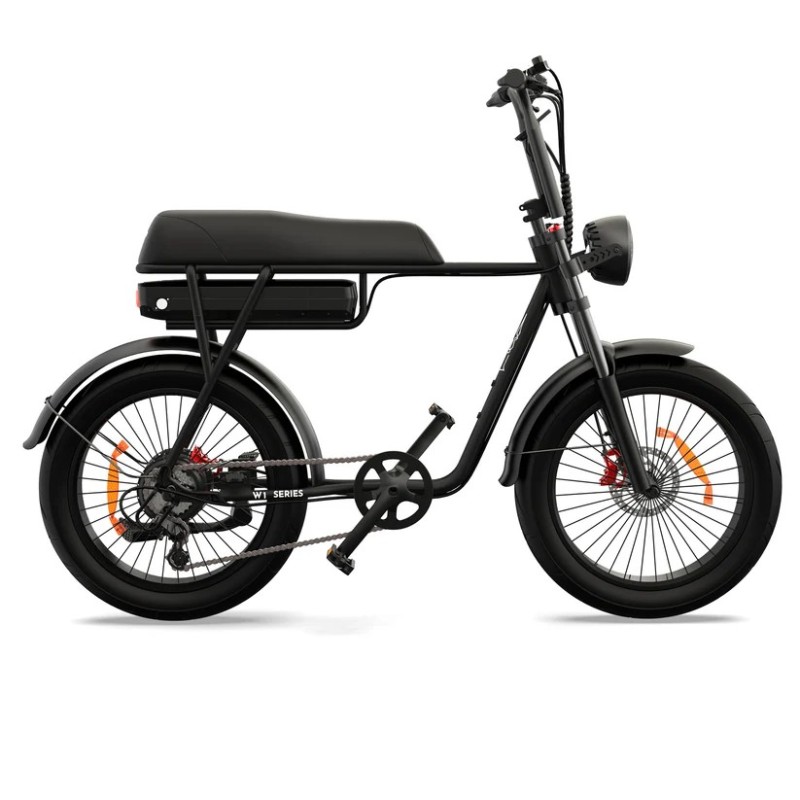
That's the case with the Koolux X9 Pro 750 W in our range: its long seat and dual battery make it a very enjoyable bike for two, but its power and speed restrict it to use on private land. For the road, choose a compliant model such as the Pinscher W1 250 W two-seater fat bike, or browse our range of road-legal 250 W fat bikes.
Child passengers: seat, helmet and footrests
In France, the rules are stricter for children. A child under five must travel in a seat specially designed for them, fitted with a restraint system, and their feet must be protected from the wheels. On a fat bike with a long seat, this means adding a suitable child seat: the seat on its own is not enough.

In France, since 2017, a helmet has been compulsory for every child under 12, whether they are riding the bike or travelling as a passenger. An adult carrying a child without a helmet can be fined. For older children and adults, a helmet is not compulsory on a compliant e-bike under French rules, but we strongly recommend one for both rider and passenger.
Good habits when riding with a child
- check that their feet reach the footrests without stretching their legs;
- teach them to keep their hands on the grab handle or around the rider's waist;
- avoid riding at night or in the rain until they are used to it.
Insurance and liability
In France, the law does not require any specific insurance for a compliant e-bike. Your personal liability cover (responsabilité civile), often included in your home insurance, generally covers damage you cause to others while cycling. However, check with your insurer that it does apply to an e-bike and to carrying a passenger.
For a more powerful machine classed as a moped, insurance becomes compulsory in France, just as for a scooter. Riding without it on public roads is an offence, and any damage caused to your passenger or to third parties would be your responsibility. This general guidance does not constitute personal advice: consult your insurer or a legal adviser about your own situation.
Getting properly equipped before riding two-up
Once you're within the legal framework, a little preparation makes riding with a passenger far more relaxed:
- Check your tyre pressure to allow for the passenger's weight, within the range shown on the sidewall.
- Test the brakes unloaded, then loaded somewhere quiet: stopping distances are noticeably longer with two on board.
- Choose a moderate assistance level when setting off to avoid jolts that unsettle your passenger.
- Fit lights and reflective gear, compulsory at night in France and useful in poor weather.
Finally, remember that range drops when you ride two-up. If you're still torn between several models, our two-seater fat bike comparison will help you decide based on how you ride.
Frequently asked questions about two-seater electric fat bikes
Does the passenger have to wear a helmet?
In France, it is compulsory for passengers under 12. For an adult on a compliant e-bike, it is only recommended. On a machine classed as a moped, an approved helmet is compulsory for everyone.
Do you need insurance for a two-seater fat bike?
In France, not for a compliant e-bike, but yes for a moped. Personal liability cover generally covers the use of a compliant e-bike. Check with your insurer that it includes carrying a passenger.
Can a 750 W fat bike be ridden on the road?
Not as a bicycle. Above 250 W or 25 km/h of assistance, it counts as a moped. In France, it must then be type-approved, registered and insured, and the rider must hold the appropriate licence.
Can a child sit directly on the long seat?
Not if they are under five: under French rules, they need a suitable seat with a restraint system. Older children can use the long seat if they can reach the footrests and sit securely.
Does the passenger need footrests?
Yes, their feet must be kept clear of the wheels. This is a safety requirement for any passenger on a cycle. Without support, the risk of a fall caused by a foot caught in the spokes is very real.
Our pick: Electric Fat Bikes
Browse all our models in the Electric Fat Bike collection.